
Why Productivity Often Collapses After Work, And What That Really Means
In my work with neurodivergent children, adolescents, and the families and professionals who support them, I frequently notice a familiar pattern: someone who holds it together all day whether at school, in meetings, or in social spaces, only to unravel once they arrive home.
Discouraged parents often speak about the “after-school crash.” Frustrated partners describe adults who appear competent and energised at work but become overwhelmed by even the smallest household tasks in the evening. And the individual themselves often carries the heaviest burden of all, a quiet, corrosive sense of shame.
From the outside, it can look like inconsistency. A lack of effort. A motivation problem.
In reality, it is often something far more neurological.
This blog explores ADHD and end-of-day cognitive fatigue through current research and lived experience, offering practical insight from the frontline of inclusive education. When we understand why productivity collapses after work, we can respond not with criticism, but with compassion, and more effective support.
Why This Matters
Developmentally and neurologically, ADHD is not a deficit of effort or intelligence. It reflects a difference in executive functioning, the brain’s system for organising, prioritising, initiating, sustaining, and regulating behaviour.
For individuals with ADHD, everyday functioning is often more effortful than it appears. Sustaining attention, filtering distractions, organising information, managing time, regulating impulses, and navigating social expectations all require sustained cognitive energy. Many are also carrying the additional load of masking, consciously or unconsciously adjusting behaviour in order to be accepted, competent, and “fine”.
This invisible labour accumulates.
By the time they arrive home, the nervous system may be depleted, even if they appeared composed and capable all day. The structured environment of school or work falls away, external accountability reduces, and the brain that has been working overtime simply runs out of fuel.
In my work, it is often evident that families interpret this collapse as laziness, avoidance, a lack of interest, or even a poor attitude. Schools may see the well-regulated learner and assume everything is manageable, leaving parents feeling misunderstood, unsupported, and increasingly discouraged. Partners, too, can feel unsettled by the stark contrast between professional competence and domestic paralysis.
What is frequently overlooked is the invisible effort that sustained the day, and the neurological exhaustion that follows.
What is often missed is the invisible labour that preceded the crash, and the very real neurological fatigue that follows.
What Research Tells Us
Current understanding positions ADHD as a neurodevelopmental condition affecting executive functioning networks, particularly within the prefrontal cortex (American Psychiatric Association, 2013; Barkley, 2015). These networks are responsible for planning, organising, prioritising, initiating tasks, regulating emotion, and sustaining effort over time.
Research consistently shows that executive functioning tasks require greater cognitive load for individuals with ADHD. Sustained self-regulation, especially in structured environments such as classrooms and workplaces, can lead to faster mental fatigue. Decision-making and task initiation become especially vulnerable when energy reserves are low. Emotional dysregulation and accumulated shame often compound these executive difficulties, creating a cycle that often feels personal but is profoundly neurological.
Emerging themes in adult ADHD research suggest that many individuals maintain professional performance through external structure, deadlines, and accountability (Asherson et al., 2016). Workplaces often provide scaffolding that supports functioning. Home environments, however, are typically less structured. Without external prompts or clear time boundaries, the brain that has worked hard all day may simply “hit pause.”
The Additude Magazine article How to Recharge Your Tired Brain After Work (Dixon, 2022) captures this phenomenon in practical terms: the ADHD brain often stalls in the evening not because of laziness, but because it needs refuelling. Organising, planning, and choosing what to do next all require cognitive fuel. When that tank is empty, paralysis is a predictable outcome.
For practice, this reframing is critical. What looks like “not doing” is often neurological depletion.
Practical Takeaways
The natural question that follows is: what do we do?
If evening paralysis is neurological depletion rather than defiance, then our response must prioritise regulation, dignity, and sustainable functioning.
Some of the strategies my clients have found helpful include:
- Building in decompression time after school or work before expecting productivity.
- Refuelling first, through food, hydration, movement, quiet time, connection, or sensory reset. For some, this may be a quiet shower before the evening begins. For others, an hour at the gym provides the movement their nervous system needs to settle.
- Planning decisions in advance to reduce evening cognitive load. A predictable meal plan or simple evening routine removes the pressure of yet another decision when the brain is already tired.
- Breaking tasks into micro-steps, focusing on one small, clearly defined action at a time. For example, instead of saying, “Clean your room,” which can feel overwhelming and undefined, start with, “Put the clothes in the laundry basket,” or “Clear just the desk surface.” For an adult, rather than “Sort out the finances,” the first step might simply be, “Open the banking app and review the balance.” Micro-steps reduce paralysis because the brain is no longer facing a large, undefined demand, it is responding to one manageable action.
- Limiting autopilot distractions intentionally, rather than reacting with shame after the fact. Screen time schedules or agreed boundaries can help reduce the pull of mindless scrolling, gaming, or passive consumption. For many individuals with ADHD, screens provide quick dopamine and temporary relief from mental fatigue, which makes them especially compelling at the end of the day. Introducing limits may initially feel uncomfortable, particularly when the brain is craving easy stimulation. However, when implemented thoughtfully and consistently, reducing autopilot screen use can significantly improve energy, task initiation, and overall evening regulation.
- Externalising executive functioning onto paper, visual cues, or digital calendars. The use of calendars, checklists, and visual schedules reduces the mental effort required to remember what comes next or what still needs to be done. When these supports are clearly visible, displayed on a wall, desk, or shared family space, they remove the additional cognitive step of having to access a phone or search through a diary. The brain no longer has to hold or retrieve the information; it can simply respond to what is already structured and visible.
- Shifting language from blame to collaboration. Instead of saying, “Why haven’t you done this yet?” or “You’re just avoiding it,” try, “I can see you’re tired. What would make this easier to start?” or “Would it help if we did the first step together?” This subtle shift reduces defensiveness, preserves dignity, and keeps the nervous system regulated enough to access problem-solving. Collaboration communicates, we are on the same team, rather than you are the problem.
- Avoiding escalation during fatigue states, when the nervous system is depleted. If an individual becomes irritable, withdrawn, or resistant in the evening, this is rarely the moment to insist on consequences, lectures, or problem-solving discussions. For example, instead of saying, “We need to sort this out right now,” it may be more effective to pause and say, “Let’s revisit this tomorrow when we both have more energy.” Difficult conversations are best held when the brain is regulated. Escalation during fatigue often increases shutdown, conflict, or shame, whereas postponing the discussion protects both the relationship and the nervous system.
At home and in classrooms, we protect regulation before productivity.
The goal is not relentless output. It is sustainable functioning, and relationships that remain intact while it develops.
In Closing
Living with ADHD can place sustained strain on individuals and on the people who care about them. By the end of the day, what may look like irritability, withdrawal, or resistance is rarely deliberate defiance. More often, it is a nervous system that has reached capacity after hours of sustained effort.
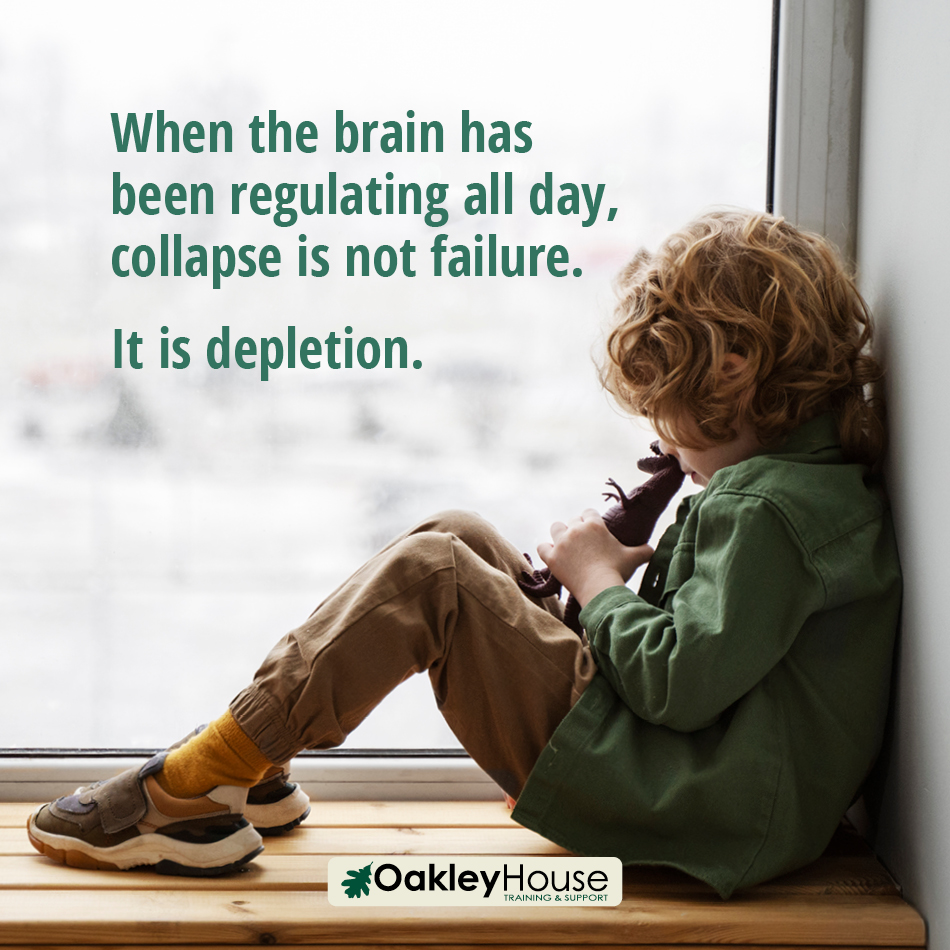
When the brain has spent the day focusing, organising, regulating, and navigating social demands, the evening “collapse” is not a character flaw. It is cumulative mental and physical fatigue. The system has simply run out of resources.
When we shift from a lens of compliance to one of regulation, everything changes. We move from blame to curiosity. From pressure to protection. From asking, “Why aren’t you trying?” to ask, “What support is needed right now?”
Further Reading & References
American Psychiatric Association (2013) Diagnostic and Statistical Manual of Mental Disorders (5th ed.). Washington, DC: American Psychiatric Publishing.
Asherson, P., Buitelaar, J., Faraone, S.V. and Rohde, L.A. (2016) ‘Adult attention-deficit hyperactivity disorder: key conceptual issues’, The Lancet Psychiatry, 3(6), pp. 568–578.
Barkley, R.A. (2015) Attention-Deficit Hyperactivity Disorder: A Handbook for Diagnosis and Treatment (4th ed.). New York: Guilford Press.
Dixon, C. (2022) ‘How to Recharge Your Tired Brain After Work’, Additude Magazine, 10 February. Available at: https://www.additudemag.com/how-to-be-more-productive-at-home-after-work/ (Accessed: 18 February 2026).


