
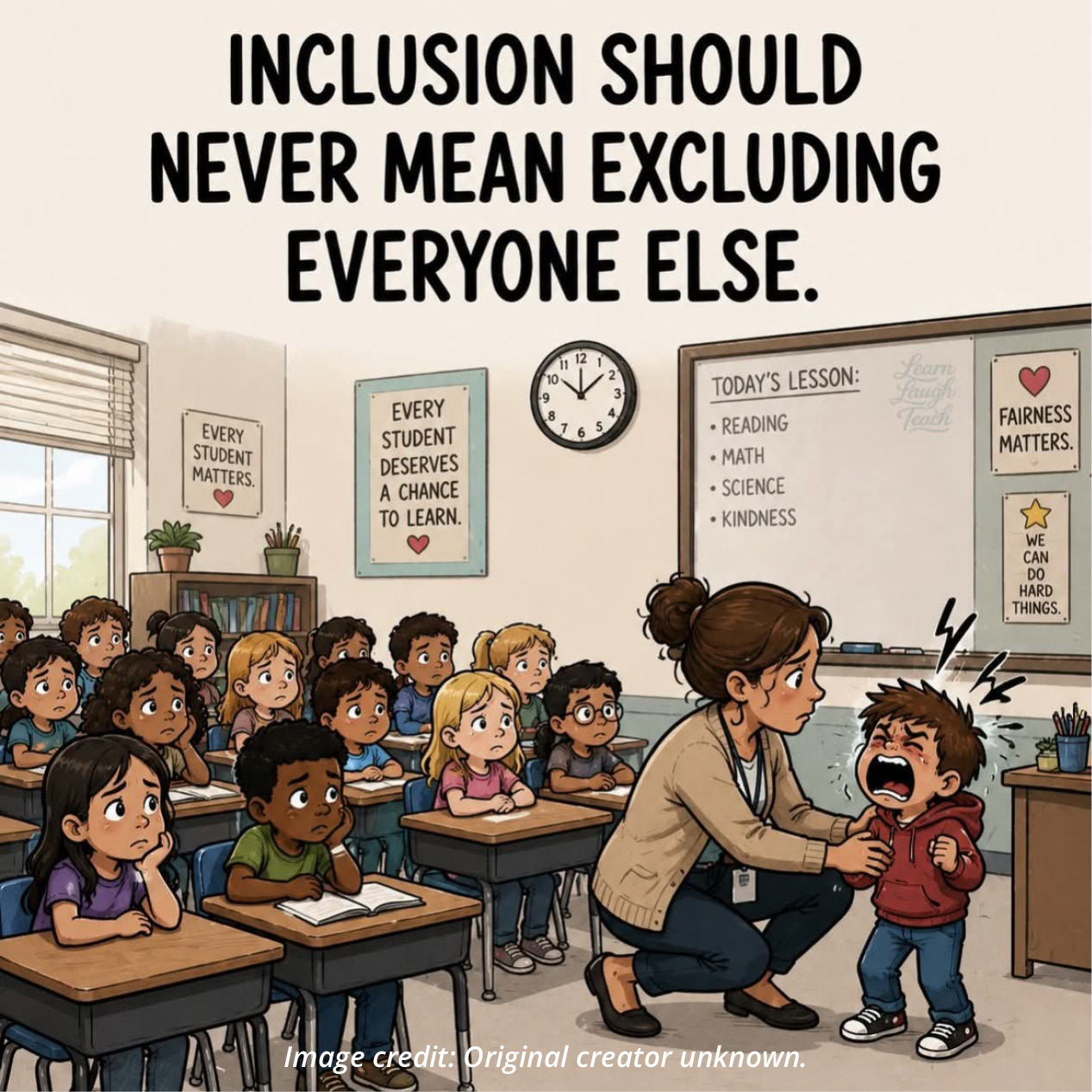
During the week, I came across the image above while scrolling through Facebook (original creator unknown). At first, I barely gave it a second glance. Like so much of what appears on our social media feeds, I simply scrolled past.
But something made me stop.
Something about the image pulled me back, and this time I looked again. Not just a quick glance, but a real look.
Suddenly, the image felt personal.
As a mother of two schoolgoing children and someone who works daily alongside educators, parents, and neurodivergent individuals, I found myself studying the faces in the classroom. The child in distress. The teacher is doing her best to respond with patience and compassion. And then the other learners, sitting quietly around them. Watching. Waiting. Existing in the background of a moment that wasn't about them.
The caption read: "Inclusion should never mean excluding everyone else."
What struck me wasn't whether the statement was right or wrong. It was the uncomfortable question it raised.
Because inclusion is one of the most important and meaningful goals in education. Yet the reality of implementing it well is often far more complex than the conversations we have about it.
As I sat with the image, I was reminded of a conversation I had earlier this year with a school principal. We were discussing the realities of inclusion and the growing complexity of modern classrooms when they made an observation that has stayed with me ever since: "Sometimes supporting a group of neurodivergent learners in a neurodiverse environment is more complex and misunderstood than supporting a neurodivergent learner in a predominantly neurotypical classroom."
It wasn't a criticism of neurodiversity, nor was it an argument against inclusion. It was an honest reflection from someone trying to navigate the reality of meeting the needs of every learner in front of them.
The image brought that conversation rushing back.
It reminded me that while we often talk about the importance of inclusion, we talk far less about the complexities of implementing it in environments where every learner's needs are valid, yet some of those needs may unintentionally compete with or impact the needs of others.
And that is what ultimately led me to write this blog.
The Beautiful Idea. The Difficult Reality
Let's be clear from the outset: inclusion is not a bad idea. It is, in principle, one of the most beautiful ideas in education.
The notion that every child deserves access to quality learning, to belong in a community, and to be seen and valued is not up for debate. It is right. It is necessary. But it is hard.
What we need to talk about, though, is what happens when inclusion in practice creates a kind of quiet exclusion for other learners. Not through malice. Not through poor teaching. But through the very real reality that some children require so much in the moment that there is simply very little left for everyone else.
The Learners We Don't Mean to Miss
Every teacher knows them.
They are the ones who are not in crisis. They are not melting down, refusing to work, or generating concern meetings and intervention plans.
They are simply getting on with things.
These are the learners who quietly fall into what I often think of as the missed middle. The child with mild dyslexia who could soar with fifteen minutes of targeted support each week, but those fifteen minutes keep going elsewhere. The learner whose attention drifts but never dramatically enough to be prioritised. The quietly anxious child who absorbs the chaos around them every day and goes home exhausted, while nobody quite realises why.
These learners often have enormous potential, but in environments where support is constantly triaged, they are the ones who wait. And wait. And eventually stop expecting support altogether.
This is not the fault of their classmates with higher support needs.
It is a systems and resource issue.
But naming it matters, because the cost is often invisible. It emerges years later in underachievement, reduced confidence, disengagement, and adults who say: "I always felt like I could have done more, but I never quite got there."
When Everyone Needs Support at the Same Time
Now let's consider a scenario that is becoming increasingly common.
A school where every learner has a profile that comes with significant support needs.
The autistic learner.
The learner with a PDA profile.
Several learners with ADHD.
A handful with complex anxiety.
The sensory-sensitive learner.
The learner with language-processing difficulties.
The learner who masks all day and collapses emotionally at home.
In theory, this sounds ideal: A school designed specifically for neurodivergent learners. A place where everyone belongs.
In practice, however, it can be extraordinarily complex and often comes at a high cost emotionally and financially.
It is a little like a restaurant where every customer has a completely different dietary requirement, there is one chef, and everyone arrives hungry at the same time expecting to be catered for at once.
And here lies one of the greatest ironies of inclusion.
The same parent who passionately advocates for their child's needs may sometimes become frustrated when another child's needs significantly impact their own child's experience.
I say this with compassion because parenting a neurodivergent child can be exhausting and advocacy often comes from a place of love, fear, and protection. But it highlights an important truth: We all believe inclusion is important, right up until it begins to affect someone we care about.
That does not make us hypocritical.
It makes us human.
What the Evidence Is Telling Us
UNESCO's frameworks on inclusive education have consistently emphasised that inclusion is not simply about placement. It is about participation, progress, belonging, and meaningful access for all learners.
The Education Endowment Foundation highlights that effective inclusion requires adequate resourcing, skilled staffing, and intentional support structures.
Research from educational psychology continues to draw attention to what some have described as the "invisible majority", learners whose needs are not severe enough to trigger intervention but are significant enough to impact their learning and wellbeing.
South Africa's White Paper 6 recognised this challenge more than two decades ago.
The tension between access and adequate support has always existed.
The difference today is that classrooms have become increasingly complex while support systems have not necessarily evolved at the same pace.
What This Looks Like Beyond the Policy Document
In a mainstream school:
- A learning support educator spends most of their time supporting two or three learners with intensive needs, leaving limited capacity for several others requiring assistance.
- A teacher continually restructures lessons to respond to dysregulation, while other learners lose the consistency they rely on.
- A gifted learner with mild ADHD coasts through school without ever reaching their potential because nobody has the capacity to stretch them.
In a specialist or neurodiversity-affirming school:
- A sensory-sensitive learner spends their day in a fluctuating state of low-level and high-level distress because the environment remains unpredictable and, at times, sensory-demanding, causing intolerance of uncertainty overall.
- A learner with a PDA profile relies on carefully structured support, but this can be disrupted when staff attention is diverted elsewhere, leaving the learner without the consistency they need to cope with demands.
- Families celebrate their child's progress while simultaneously experiencing frustration when another learner's needs affect the classroom environment.
Some Uncomfortable Questions Worth Asking
For Educators and School Leaders
- Who in your classroom is being quietly overlooked while more visible needs are being met?
- If one learner requires intensive daily support, what structures exist to ensure this does not come entirely at the expense of others?
- Is your inclusion policy truly focused on participation and belonging, or has it become primarily about placement?
For Parents
- When advocating for your child's needs, do you also hold space for the reality that every child in that room has needs that matter deeply to someone?
- What does belonging mean when not everyone in the environment is currently experiencing it?
Where Do We Go From Here?
Review and reflect on where support time is actually being spent.
Systematically identify learners who may not meet intervention criteria but are nevertheless struggling to thrive in the current environment.
Remember that placement alone is not inclusion.
Create honest conversations with parents about the realities and complexities of meeting diverse needs.
Continue advocating for better staffing, training, and resources.
Resist the urge to choose sides.
Allow yourself to sit with the complexity.
The Goal Was Never Placement ... It Was Belonging
The image that opened this article shows a classroom mid-moment. One child is distressed. A teacher is doing her best. A room full of learners who are waiting.
It is not a picture of failure. It is a picture of an impossible situation being held by one person who was never given enough resources to meet every need in the room.
Perhaps that is the conversation we need to have.
The goal was never simply to place children together in the same classroom. The goal was always belonging. The goal was always participation. The goal was always growth, dignity, safety, connection, and opportunity.
Inclusion is one pathway towards those outcomes.
But when we focus only on where learners are placed and lose sight of what they actually experience once they are there, we risk achieving inclusion in name while missing belonging in practice.
The child in distress deserves support. The sensory-sensitive learner deserves support. The gifted learner deserves support. The anxious learner deserves support. The quiet learner sitting in the middle of the room, who has not been noticed in weeks, deserves support too.
The challenge is not deciding whose needs matter.
The challenge is building educational systems where everyone's needs have a genuine chance of being seen.
Further Reading & References
UNESCO. (2020) Inclusion and Education: All Means All. Global Education Monitoring Report. Paris: UNESCO. Available at: https://gem-report-2020.unesco.org/. (Accessed: 2nd June 2026).
Education Endowment Foundation. (2021) Special Educational Needs in Mainstream Schools: Guidance Report. London: EEF. Available at: https://educationendowmentfoundation.org.uk/education-evidence/guidance-reports/send. (Accessed: 3rd June 2026).
Department of Education, South Africa. (2001) White Paper 6: Special Needs Education — Building an Inclusive Education and Training System. Pretoria: DoE. Available at: https://www.education.gov.za/Portals/0/Documents/Legislation/White%20paper/whitepaper6.pdf. (Accessed: 2nd June 2026).
British Psychological Society. (2019) Inclusive and Special Education: BPS Position Statement. Leicester: BPS. Available at: https://www.bps.org.uk. (Accessed: 3rd June 2026).
Norwich, B. (2014) Recognising value tensions that underlie problems in inclusive education. Cambridge Journal of Education, 44(4), pp. 495-510. Available at: https://doi.org/10.1080/0305764X.2014.963027. (Accessed: 4th June 2026).
Alphabet Blossom (2026). Inclusion should never mean excluding everyone else [Image]. (Facebook). 2nd June. Available at: https://www.facebook.com/share/1HbNYD1hwS/. (Accessed: 5 June 2026).


